Domain Generator: How to Generate Creative and Available Domain Name Ideas Published: 05 May, 2026
Introduction
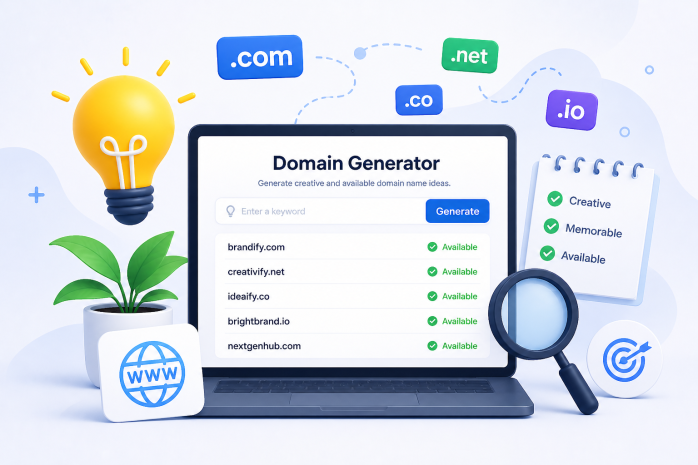
Naming a website is one of the most challenging — and most exciting — parts of building an online presence. You might spend hours brainstorming, only to discover that every name you think of is already taken. This is where a Domain Generator tool becomes invaluable. It does not just check availability — it actively creates domain name ideas for you, often producing creative combinations you would never have thought of on your own.
In this article, we will explore what a domain generator is, how it works, the different strategies it uses to generate names, and how you can get the most out of it when building your brand online.
What Is a Domain Generator?
A domain generator is an automated tool that creates lists of domain name suggestions based on keywords, themes, or phrases that you provide. Instead of manually brainstorming and checking one name at a time, a domain generator runs hundreds or even thousands of combinations through availability databases simultaneously, presenting you with a curated list of available options.
These tools are especially useful when:
- Your first-choice domain is already taken
- You are struggling to come up with a unique, available name
- You want to explore creative angles for your brand
- You are building multiple niche websites and need to name them efficiently
How Does a Domain Generator Work?
At its core, a domain generator combines algorithmic logic with real-time domain availability checks. Here is the process:
Step 1: Keyword Input
You provide one or more keywords related to your website's niche, brand, or purpose. For example, if you are building a fitness blog, you might enter words like "fit," "health," "strong," "body," or "training."
Step 2: Algorithmic Name Generation
The generator applies various linguistic and structural patterns to your keywords to create possible domain names. Common techniques include:
- Prefix addition: Adding common prefixes like "get," "my," "the," "go," or "try" — e.g., getfitnow, myfitlife, thefitstudio
- Suffix addition: Adding suffixes like "hub," "zone," "lab," "pro," "hq," or "ly" — e.g., fitnesshub, healthzone, bodylab
- Word combination: Merging two related keywords — e.g., fitbody, healthforce, strongmind
- Portmanteau creation: Blending parts of two words — e.g., fitrition (fit + nutrition)
- Rhyming and alliteration: Generating names that are catchy and fun to say
- Random syllable insertion: Adding short, memorable syllables to create unique, brandable names
Step 3: Availability Check
Each generated name is instantly cross-referenced against domain registry databases to filter out already-registered names. Only available options are shown to the user.
Step 4: Results and Filtering
You receive a list of available domain names, often with options to filter by TLD (.com, .net, .io, etc.), length, or style.
Types of Domain Generation Strategies
Domain generators do not all work the same way. Different tools employ different strategies, and understanding these can help you choose the right one for your needs.
1. Keyword-Based Generation
This is the most common approach. You enter one or two keywords, and the tool creates combinations based on those words. It is ideal for businesses that have a clear theme or niche.
Example: Input "travel blog" → Output suggestions like travelbliss.com, thewanderhub.net, blogtravel.io
2. Industry-Specific Generation
Some advanced generators ask you to select an industry (e.g., tech, fashion, food, finance) and then generate names tailored to that sector's naming conventions and popular terminology.
Example: A tech-focused generator might produce names with endings like "-ly," "-ify," "-hub," or "-stack," which are common in the tech startup world.
3. AI-Powered Generation
Modern domain generators powered by artificial intelligence can understand context and semantic meaning. Instead of just combining words mechanically, they understand the vibe, emotion, and branding intention behind your inputs.
Example: You describe your brand as "a cozy online bookstore for indie readers," and the AI suggests names like pagehollow.com, shelfwhisper.io, or inkandnook.com
4. Random Generation
For those who want to discover completely unexpected names, some tools offer purely random generation. These can surface creative, out-of-the-box names that you never would have thought of intentionally.
5. Expired Domain Generation
Some generators specifically focus on finding recently expired domain names that match your keywords. Expired domains can carry existing backlinks and domain authority, making them valuable for SEO purposes.
Why Use a Domain Generator Instead of Manual Brainstorming?
There are several compelling reasons to use a domain generator over manual brainstorming:
Speed and Efficiency
A generator can produce and check hundreds of domain combinations in seconds. Manual brainstorming followed by individual availability checks could take hours for the same output.
Expanded Creativity
Even the most creative person has cognitive limits. A generator applies patterns and combinations that a human brain might not naturally explore, expanding the creative possibility space significantly.
Immediate Availability Feedback
There is nothing more frustrating than falling in love with a domain name only to find it is registered. Domain generators show you only what is available, eliminating that disappointment.
TLD Discovery
Many users default to thinking only about .com domains. A generator introduces you to alternative TLDs that may be more available and equally effective, such as .io, .co, .app, or niche extensions like .photography or .consulting.
Inspiration for Branding
Even if you do not register a generated name exactly as produced, the suggestions can spark ideas. A generator output might not be perfect, but it can point you in a creative direction you had not considered.
How to Use a Domain Generator Effectively
Getting the best results from a domain generator requires some strategic input. Here are practical tips:
Tip 1: Start with Your Core Brand Concept
Before entering anything, spend five minutes defining the essence of your brand. What emotions do you want to evoke? What problem are you solving? What is your unique angle? Write down three to five words that capture this essence — these become your starting keywords.
Tip 2: Use Multiple Keywords
Enter combinations of words rather than a single keyword. Generators that accept multiple inputs tend to produce more targeted and creative results.
Tip 3: Experiment with Different TLD Filters
Do not limit yourself to .com. Explore .io for tech projects, .co for companies, .org for communities, .blog for content sites, and many others. You might discover that your ideal name is perfectly available under a modern TLD.
Tip 4: Try Synonyms
If your primary keyword is not generating good results, try synonyms. A fitness site might try "wellness," "vitality," "stamina," or "active" instead of just "fitness."
Tip 5: Prioritize Brandability Over Exact Keywords
A brandable name is often more valuable than a keyword-rich name. Generated names like Trello, Slack, or Canva are not keyword-heavy, but they are unforgettable. Look for generated names that are short, easy to pronounce, and distinctive.
Tip 6: Filter by Length
Shorter domains are generally better. Use filters (if available) to show only domains under 12 or 15 characters.
Tip 7: Save Multiple Options
Do not settle on the first available name you like. Save a shortlist of five to ten options and sit with them for a day. Say them out loud, imagine them on a business card, and test how they feel as a brand identity.
Understanding Brandability vs. Descriptiveness
When generating and evaluating domain name options, you will often face a choice between two philosophies:
Descriptive Domains
These directly describe what your website is about.
- Example: onlinecookingclasses.com, cheapflightstoeurope.net
- Pros: Users immediately understand the purpose; can help with niche SEO
- Cons: Often already taken; hard to build a distinct brand around; not scalable if you expand
Brandable Domains
These are invented or abstract names that do not directly describe the product or service.
- Example: Spotify, Airbnb, Dropbox
- Pros: Unique and trademarkable; memorable and scalable; stronger long-term brand potential
- Cons: Requires more marketing to build recognition; users do not immediately know what you do
For most modern web projects, especially those with ambitions of growth, brandable domains are the stronger long-term investment. Domain generators are excellent at producing brandable name candidates.
Red Flags: Domain Names to Avoid
Even if a domain generator suggests a name and it is available, not every suggestion is worth registering. Watch out for these issues:
- Trademark conflicts: A generated name might accidentally match or closely resemble a registered trademark. Always do a trademark search before registering.
- Confusing spelling: If the generated name uses unconventional spelling, users might misspell it and land on a competitor's page.
- Negative connotations in other languages: If your audience is global, check that your domain name does not have offensive or embarrassing meanings in other languages or cultures.
- Hyphens and numbers: If a generator suggests names with hyphens or numbers, skip them. They look unprofessional and are hard to communicate verbally.
- Too long: Names over 20 characters are generally too long for practical use.
Domain Generator and SEO Considerations
While domain generators focus on creativity and availability, keep these SEO-related factors in mind:
- Avoid keyword stuffing in the domain: Exact match domains (EMDs) like cheaphotelsinnewyork.com were once SEO gold, but modern search engines value brand signals more than keyword matching in URLs.
- Choose a domain you can build authority around: The best SEO factor related to your domain is the quality of content and backlinks you build over time.
- Domain age matters: Consider whether you want a fresh domain or a previously registered one with existing history. Some generators specialize in surfacing expired domains with backlink profiles.
- HTTPS compatibility: Make sure your registrar supports SSL certificates for HTTPS. This is a confirmed Google ranking signal.
After Using the Generator: Next Steps
Once you have found a great domain name through a generator, here is what to do:
- Double-check social media handle availability — Consistent branding across platforms requires matching handles.
- Register the domain immediately — Good available names can be registered by others at any time.
- Consider buying variations — Register common misspellings and alternative TLDs to protect your brand.
- Set up WHOIS privacy protection — This hides your personal information from public databases.
- Connect your domain to a hosting provider — Start building your website and establishing your online presence.
Conclusion
A domain generator is one of the most powerful tools in the arsenal of any website builder, entrepreneur, or blogger. It turns the often frustrating task of finding an available, creative, and brandable domain name into a fast and even enjoyable experience. By understanding how these tools work and applying strategic thinking to your inputs and selections, you can discover the perfect domain that sets your online venture up for lasting success.
Do not let the search for a perfect domain name slow you down. Use a domain generator, explore your options, and take that first decisive step toward building your digital identity.